B2B buyers in 2026 aren’t shopping for AI in general, they already know what AI services B2B companies are willing to pay for in 2026, and they’re asking for specific outcomes in specific workflows by name. Many agencies are still pitching “AI transformation” while buyers have moved past that conversation entirely. The agencies closing deals aren’t winning on discovery calls. They’re winning because they walk in with a ready answer to a question the buyer already formed before the meeting started.
This article covers the five service categories B2B buyers are actively budgeting for right now, what those services actually cost, and how to package them so buyers say yes without a long approval cycle. If you’re an agency owner trying to figure out where to focus, this is the shortlist.
What AI Services Are B2B Companies Willing to Pay For in 2026, The Top Three
These three categories show up consistently across B2B procurement conversations. Buyers aren’t using vague language when they ask for them. They know the workflow, they know the problem, and they have a number in mind.
Cold email automation with real personalization
The shift here isn’t subtle. Buyers are done with blast-and-pray sequences, and they know the difference between AI-generated noise and a value-led email that references actual ICP signals from CRM data. What they’re purchasing isn’t just a sequence tool, they’re buying lead quality, deliverability accountability, and a filtering system that catches weak output before it hits a prospect’s inbox. Multi-point quality checks on every email before sending are becoming a standard buyers expect and ask about directly. Boutique cold email services typically run $2,500 to $5,000 per month, with mid-market multi-channel packages reaching $4,000 to $7,000. Total engagement cost, including domains and data, lands between $4,000 and $9,000 per month for most clients.
Revenue attribution that connects content to closed deals
CFOs are asking a specific question: which content spend is actually generating pipeline? Last-click attribution doesn’t answer it, and most teams know that. What buyers want is multi-touch attribution tied directly to CRM records, specifically the ability to see which blog posts, LinkedIn threads, or email campaigns appear in closed-won deal timelines. Most teams can’t answer that question today, which is exactly why they’re paying someone to fix it. Attribution setup runs $10,000 to $50,000 as a fixed project, typically followed by a $2,000 to $5,000 per month maintenance retainer. Companies that implement this correctly report reallocating 18 to 22 percent of their marketing budget across channels once they can see what’s actually working.
Visitor identification and anonymous traffic intelligence
The large majority of website visitors, industry estimates commonly place the figure around 95 percent, never fill out a form. A meaningful share of those visitors are in-market accounts that match your ICP exactly. Tools that surface company-level identity from website traffic without form fills are now a consistent line item in B2B procurement conversations, and buyers are asking specifically about data privacy and compliance during evaluation. The value proposition is direct: turn passive traffic into actionable outreach lists. Managed visitor identification packages typically range from $1,500 to $4,000 per month. Clients who act on identified accounts within five minutes of a high-intent visit report significant increases in qualified leads and measurable first-mover advantages in deal capture.
Two More AI Services B2B Buyers Are Budgeting for in 2026
These two categories were considered optional or experimental two years ago. They’re now deliberate budget line items, and the buyers requesting them are specific about what they want delivered.
Podcast and long-form content repurposing at scale
Companies are sitting on recorded audio and video content that generates no downstream pipeline. One podcast episode contains enough material for LinkedIn posts, newsletters, Twitter/X threads, and email sequences, but most marketing teams don’t have the bandwidth to produce all of it. What buyers are purchasing is automated transcription and AI podcast tooling, multi-format output, and A/B headline variants delivered on a consistent schedule. The business case isn’t about content volume. It’s about distribution efficiency: producing content is no longer the bottleneck, but getting it in front of the right audience still is. Managed podcast repurposing typically runs $2,500 to $7,000 per month depending on episode volume and output depth, with enterprise engagements reaching $10,000 per month when video production is included.
RevOps tooling and pipeline automation consulting
Buyers in this category want someone to stitch together their HubSpot, Gong, Slack, and Stripe data into a coherent revenue intelligence picture. This isn’t software selection, it’s the consulting layer that maps the workflow, builds the automation, and establishes a weekly operating rhythm the revenue team can actually follow. A structured weekly cycle that produces a pipeline report, an identified visitor list, and a content attribution summary is a specific deliverable buyers respond to because it replaces a recurring meeting with a document that already contains the answers. RevOps consulting engagements start at $5,000 per month for advisory work and reach $25,000 per month for full implementation. These are among the stickiest engagements in the agency space because the buyer’s entire operating rhythm depends on what you build.
What These AI Services Actually Cost: Pricing Benchmarks That Matter
Buyers don’t walk in blind. They’ve researched pricing before the first call, and if you don’t anchor numbers early, you lose the framing. These aren’t ceiling prices, they’re entry points for buyers who already understand the value.
Retainer vs. project-based pricing across service types
The clearest pattern across all five service categories: initial setup or audit work prices as a fixed project, and ongoing delivery prices as a retainer. Here’s how the ranges break down:
- Revenue attribution setup: $10,000 to $50,000 as a project, followed by a $2,000 to $5,000 monthly retainer
- Cold email automation: $2,500 to $7,000 per month depending on volume and personalization depth
- Visitor identification: $1,500 to $4,000 per month (tool plus management)
- Podcast repurposing: $2,500 to $7,000 per month for standard to mid-volume engagements
- RevOps consulting: starts at $5,000 per month
Buyers expect to see these numbers because the market for enterprise AI adoption has matured. Showing up without a pricing framework signals inexperience before you’ve said anything else.
The ROI signals buyers need before they sign
Buyers in 2026 aren’t asking whether you can do the work. They’re asking what it will return. The specific KPIs they want to see include reduction in time-to-qualified-lead, percentage of traffic converted to identified accounts, and pipeline coverage improvement. HubSpot has published data from its AI content assistant showing measurable lifts in email open rates and lead conversions, figures that vary by industry and list quality but give buyers a directional benchmark. Outcome data on AI-driven lead prioritization points to shorter sales cycles and higher conversion rates, though results depend heavily on data quality and workflow integration. Buyers don’t want generic figures. They want those benchmarks mapped to their own deal size, their current traffic volume, and their existing content output. That translation is the actual value you’re selling.
The Objections You’ll Face and What to Say
Every AI services sales conversation runs into the same two walls, and knowing them before the call is the difference between a closed deal and a stalled one.
“We already have tools for that”
This objection is almost always a half-truth. Buyers have tools that touch the workflow, but not tools that integrate it, score it, and produce a clear output. The counter is simple: ask what report their current stack produces on content-to-pipeline attribution or anonymous visitor identification. If they can’t answer in under 30 seconds, they don’t have a solution, they have data. The distinction between overlap and orchestration is the core of this objection. Buyers have already paid for software licenses. What they don’t have is someone who makes those systems produce a coherent answer. That’s what they’re paying you for, and it’s a fundamentally different purchase than another tool subscription.
“We need to see it work before we commit”
Handle this with a scoped proof-of-concept. A defined four-to-six-week pilot in the $5,000 to $15,000 range is easier to approve than a multi-month retainer, and it works precisely because it’s structured as a complete deliverable, not a demo. Note that scope determines price, a standalone diagnostic sits at the lower end, while a more integrated pilot runs higher. Build the pilot around one service category, produce a visible output like a revenue attribution report or an identified visitor list with outreach recommendations, and price the full engagement off the pilot results. The pilot needs to feel finished, not preliminary. A buyer who receives a real deliverable in week six doesn’t need to be convinced the full engagement is worth it. The output makes the argument.
Why Packaged AI Systems Beat Building From Scratch for Agency Owners
Building a custom AI revenue system to serve B2B clients takes months, requires a developer, and produces something that works for one client type at best. The math rarely works at agency scale, and the opportunity cost is significant when buyers are already asking for specific deliverables you haven’t built yet.
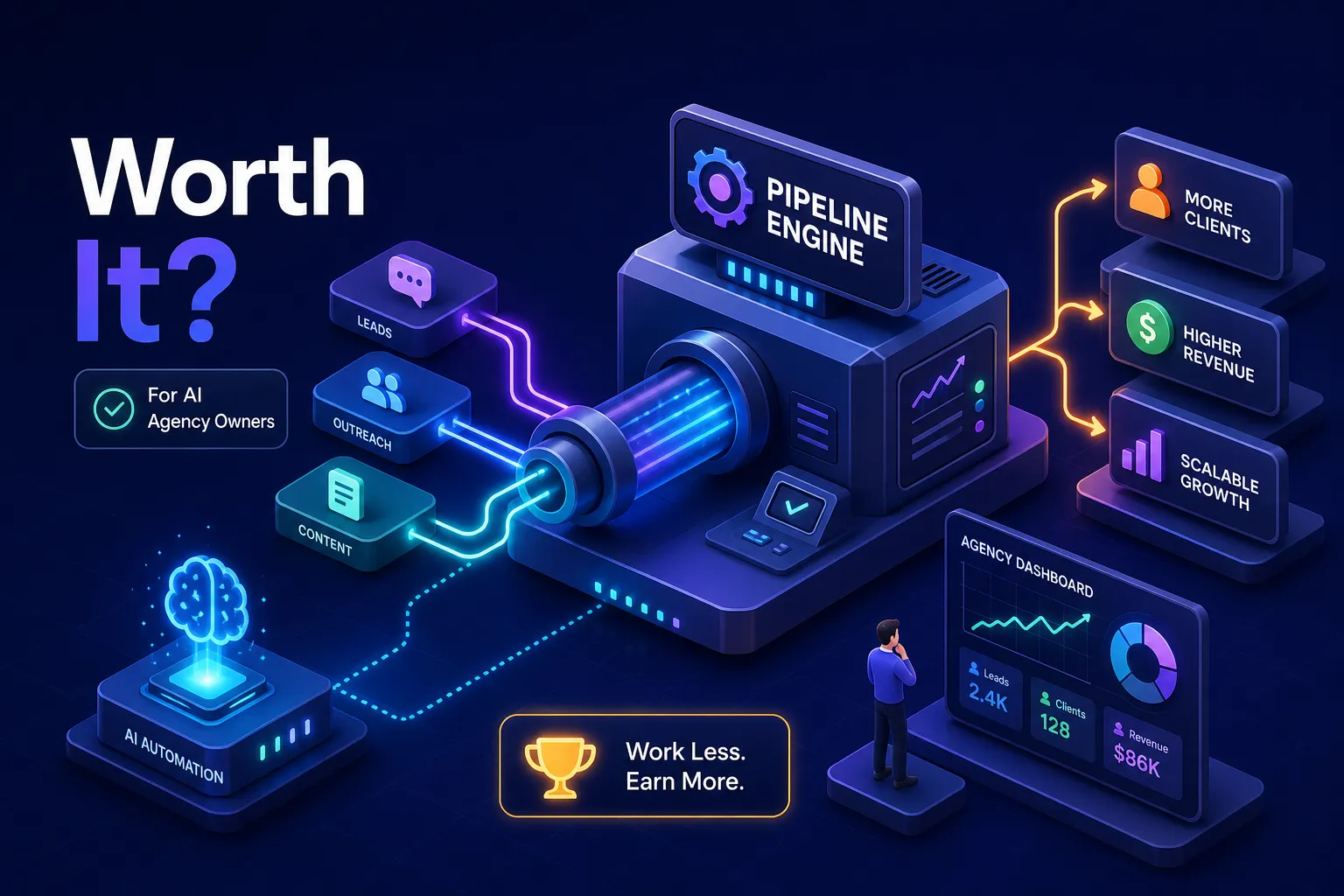
Pipeline Engine is built around five specialist agents that map directly to the five service categories B2B buyers are actively purchasing: cold email, revenue attribution, visitor identification, podcast repurposing, and RevOps automation. Pre-built integrations connect to HubSpot, RB2B, Gong, Slack, and Instantly, the tech stack B2B buyers already run. Agency owners who deploy it walk into buyer conversations with a concrete answer to specific requests rather than a general pitch about AI potential.
Agency owners who deploy it walk into buyer conversations with a concrete answer to specific requests rather than a general pitch about AI potential. Pipeline Engine is available in two formats, a no-code browser workspace for non-technical users and a Python CLI for developers who need API or CRM integrations, and includes full source code ownership with no royalties. The system can be rebranded under your own name, which shifts the conversation from vendor selection to partnership. You’re not reselling someone else’s tool; you’re delivering a proprietary revenue system priced at whatever value you’ve built into your positioning. Each agent also shares intelligence back into the others, ICP profiles, headline libraries, attribution data, so output quality improves as the system runs. That compounding effect is what turns one-time projects into long-term retainers.
How to Position These Services So Buyers Say Yes Fast
Most agency pitches fail before the pricing conversation because the service isn’t tied to a specific buyer pain. When you reframe around the outcome the buyer is already trying to achieve, the close gets shorter.
Buyers don’t budget for “AI automation.” They budget for “reduce SDR cost by 40 percent” or “prove content ROI to the CFO by Q3.” Position your packages around those specific outcomes. A RevOps bundle that delivers a weekly pipeline report, an identified visitor list, and a monthly attribution audit is a named solution with a named result, a much easier approval than a list of AI capabilities. A practical three-tier model works well here: a diagnostic entry offer in the $5,000 to $15,000 range, a core monthly service bundle, and a full system engagement at a premium retainer. Each tier has a clear output and a clear price anchor.
When buyers push back on price, they’re usually testing whether you believe in what you’re selling. Use documented ROI benchmarks as anchors. If your cold email service consistently adds 15 qualified meetings per month and the buyer’s average deal value is $40,000, the math justifies a $6,000 per month retainer without an argument. Show the calculation. Buyers who see you operate from data close faster and sign longer contracts, because you’re not defending your price. You’re explaining their return.
The Only Question Left Is Who Shows Up Prepared
Understanding what AI services B2B companies are willing to pay for in 2026 isn’t a research project anymore, it’s a sales prerequisite. The five categories covered here are not predictions. Cold email automation, revenue attribution, visitor identification, podcast repurposing, and RevOps tooling are active budget line items right now. Buyers have already decided to spend money in these areas. The only question is whether they spend it with you or with someone else.
Knowing the pricing benchmarks and objection patterns in advance gives agency owners a real structural advantage. The buyer’s questions aren’t surprises, and neither are the numbers. What closes deals is showing up with a system that already does what the buyer is asking for, priced at a point that reflects documented ROI and packaged around an outcome they’ve already committed to achieving. Pipeline Engine exists so agency owners don’t have to build that answer from scratch. The buyer demand for these generative AI solutions for B2B is already there. The system that covers it already exists. The only variable is who walks into the room ready to deliver it.