If you’re an AI agency owner asking whether Pipeline Engine is worth it for AI agencies, you’re probably stuck between two bad options: stitching together single-use automation tools that never quite talk to each other, or staring down a $75,000-plus custom build that takes months before a single client dollar comes in. Whether Pipeline Engine (Adam2Scale) is worth it for your agency depends on which of those situations describes you right now, and whether you’re serious about owning a productized revenue system instead of billing hours on one-off projects. This article breaks down what the system actually does, what it costs to ignore, and who it’s genuinely built for, no grand promises, just an honest look at the architecture, the math, and the operational reality of deploying something like this in a real agency context.
What Pipeline Engine Actually Delivers
Five Specialist Agents, Not a Generic Tool
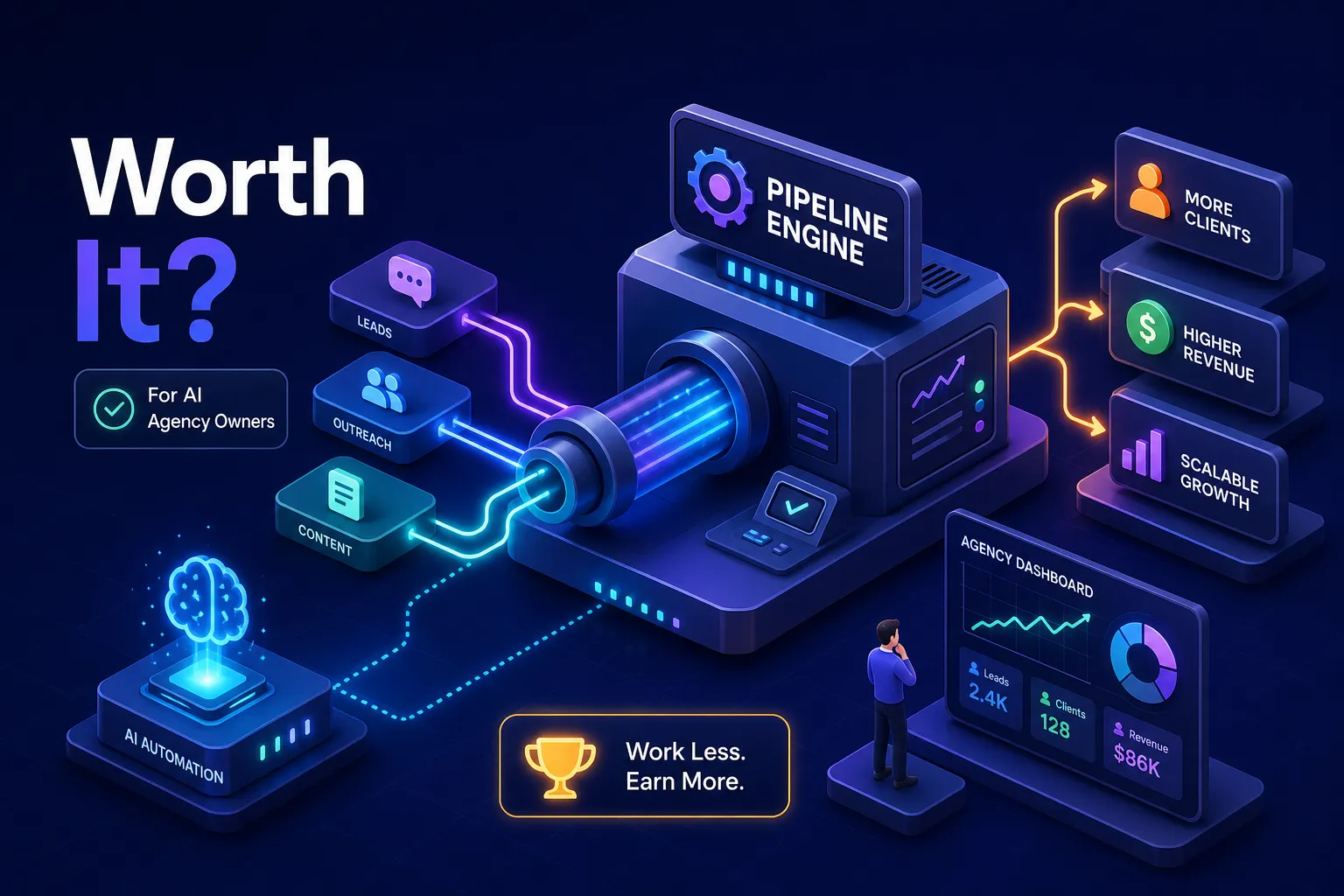
According to Adam2Scale’s product documentation, Pipeline Engine is built around five purpose-built AI agents, each targeting a specific, high-leverage B2B growth function. The cold email module handles outreach with a 24-point AI slop detector and ICP extraction from CRM deal CSVs. The content-to-revenue attribution agent connects blog and content output to actual pipeline deals in HubSpot. The invisible pipeline agent integrates with visitor identification tools, such as RB2B, to convert anonymous website traffic into qualified leads. The podcast repurposing engine transcribes audio via the Whisper API and auto-generates LinkedIn posts, Twitter threads, newsletters, and A/B headline variants. Competitive SEO rounds out the five, with search intelligence feeding back into content and outreach decisions.
This isn’t a Swiss Army knife trying to do everything at once. Each agent has a defined job, and that specificity is what makes it deployable without months of configuration work.
The Compounding Flywheel Most Tools Skip
The architectural differentiator isn’t the agents individually, it’s what happens when they share intelligence. The cold email module pulls from the same ICP data that the content attribution agent refines from closed deals. The podcast engine generates content that feeds the SEO agent. Headline libraries built from high-performing outreach inform new content. The shared knowledge base is what separates Pipeline Engine from a prompt pack or a standalone LLM orchestration workflow. Each agent improves as the others run, which means the system compounds over time rather than plateauing after the first deployment.
Most agencies would never architect this from scratch. Not because they lack the talent, but because building a flywheel like this intentionally demands a systems design mindset that’s genuinely rare when you’re also managing client delivery every week.
Two Delivery Formats Built for Different Operators
Per vendor specifications, Pipeline Engine ships in two formats. The Desktop format is a no-code, browser-based prompt workspace built for agency owners running Claude.ai or similar interfaces who want to deploy without touching code. The Python CLI codebase is for developers who need CRM and API integrations baked in from the start. Both come with full source code. In practice, most agency owners start with the Desktop format to get a first client deployed fast, then migrate to the CLI as technical capacity grows or when a client requires deeper integrations.
Is Pipeline Engine Worth It for AI Agencies? The ROI Case
What Building a Comparable Agentic AI Pipeline Actually Costs
A basic API-wrapped prompt engineering pipeline runs $75,000 to $150,000 and takes 4 to 10 weeks to reach a functional prototype, based on industry cost benchmarks for US-based engineering teams. An enterprise-grade pipeline with fine-tuning and a full RAG setup can run $300,000 to $750,000 with 9 to 18 months to production maturity. For an AI agency, that’s product cost absorbed before a single client dollar comes in, with no guarantee the result is resellable. Industry analyses of custom LLM development costs and the hidden cost of building your own LLM support these benchmarks.
Beyond the build, ongoing costs compound fast. Teams typically need 6 to 10 engineers minimum to maintain a production-grade agentic system, and personnel costs exceed infrastructure costs by a 2x to 3x factor over three years. The math doesn’t favor building unless you have deep pockets and a long runway.
The Break-Even Case for a White-Label System
With Pipeline Engine, break-even comes down to one variable: how fast you sign a paying client. ABM-style pipeline programs typically show 3 to 6 month break-even periods and ROI ranging from 3x to 10x when the underlying system is deployed correctly, based on observed agency engagement data. White-label AI automation retainers for B2B clients in 2026 average around $3,200 per month, with mid-market engagements ranging from $1,500 to $8,000 depending on scope. Run the math: a single client at $2,500 per month covers a typical investment in well under 90 days. Two clients, and you’re generating margin on a system you own outright.
The zero-royalty model is the multiplier. Every dollar you bill stays with you, there’s no platform taking a percentage cut as your client roster grows, which means margin expands rather than compresses as you scale.
Who This System Is Actually Built For
The Agency Profile That Gets Maximum ROI
According to Adam2Scale, the system comes pre-loaded with ICP playbooks, a 30-day revenue action plan generator, and a structured Monday-through-Friday orchestrator routine. That means client-delivery infrastructure is already built before you open it. AI agency owners with existing B2B clients, RevOps consultants who want a productized AI offering, and prompt engineers looking for a structured resellable system get the most out of Pipeline Engine for AI agencies. These are operators who can deploy immediately rather than spending weeks building delivery frameworks from scratch. For a focused deep-dive on the visitor-identification and conversion capability, see The invisible pipeline agent, Adam2Scale.
The Monday-through-Friday orchestrator routine is particularly useful for agencies that struggle with consistent client delivery. It removes the “what do we do this week” problem entirely.
Where It Doesn’t Fit
If your agency has no B2B client pipeline to sell into, or you’re shopping for a one-off automation project rather than a recurring revenue product, this system is overkill. Solo freelancers billing project fees without recurring retainers may find the white-label ownership model less valuable until they have clients ready for it. The five-agent architecture is designed for ongoing deployment, not a single deliverable. Buying it before you have a client to deploy it to means paying for capacity you’re not using.
The White-Label Ownership Model in Practice
What Full Source Code Ownership Actually Means
This isn’t a license you’re renting. Per Adam2Scale’s stated commercial terms, agencies get the complete source code, rebrand it under their own product name, and own the client relationship entirely, no royalties, no revenue sharing, no exposure to Pipeline Engine’s future pricing decisions. For more background on the product architecture and delivery model, see The Pipeline Engine, Adam2Scale. The contrast with typical SaaS tools matters here: with a standard platform, every price increase the vendor makes erodes your margin. With full source code ownership, your cost base is fixed at purchase.
Most white-label SaaS arrangements involve ongoing fees that compound over time, making them more expensive the more successful you become. This model inverts that. As your agency grows, the system becomes more profitable, not less.
How Agencies Price and Structure the Resale
Two models work well in practice. The first is a flat monthly retainer where the system is delivered as a managed service, typically priced at $2,500 to $5,000 per month for mid-market B2B clients. The second is a one-time productized sale with optional support tiers for agencies that prefer project-based client relationships. Adam2Scale includes pre-built connector guides for HubSpot, Gong, Slack, Stripe, Instantly, and Brave Search, which can significantly shorten deployment timelines and give technically unsophisticated B2B clients a concrete reason to pay premium rates. Agencies don’t need to explain how it works. They show measurable pipeline output, and that justifies the price.
Operational Risks to Plan for Before You Deploy
Agentic Pipelines in Production Are Not Set-and-Forget
According to Gartner and McKinsey research on enterprise AI deployments, 40 to 90 percent of enterprise agentic projects fail to reach production, primarily due to observability gaps, cascading agent errors, and cost escalation as complexity grows. Pipeline Engine’s structured weekly orchestration cycle addresses some of this by keeping outputs consistent and predictable, but agencies still need basic operational readiness. Someone has to monitor outputs, adjust ICP data as client deals evolve, and catch semantic failures where a tool succeeds technically but returns wrong data. That’s not a flaw in the system, it’s the reality of any agentic deployment. Industry writing on observability challenges in multi-agentic environments and practical analyses of why most AI agents fail in production dives into these failure modes in useful detail.
The failure modes aren’t about model quality. They’re about integration gaps, data quality, and scope creep. Agencies that expect a fully autonomous system with zero oversight will run into trouble. Agencies that treat it as a high-leverage tool requiring a weekly human review will get the compounding results it promises.
What You Need in Place Before Going Live with a Client
Three practical requirements before deployment:
- An active B2B client CRM, HubSpot is preferred given the native integration support.
- At least one live content channel, a blog, podcast, or email program to feed the content attribution agent.
- A defined ICP, either already documented or derivable from existing deal data in the client’s CRM.
Agencies that try to deploy without these in place will burn setup time that should be going toward client results.
The Honest Verdict: Which Agencies Should Move Forward
The Profile That Should Pull the Trigger
So is Pipeline Engine worth it for AI agencies? For the right operator, the answer is straightforwardly yes. The strongest fit is an AI agency owner with existing or near-term B2B clients who wants to stop selling hours and start selling a productized revenue system. That includes RevOps consultants who want a measurable AI-powered toolkit they can deliver under their own brand, and no-code operators who want enterprise-grade output without hiring a developer. These operators recover the investment fastest and compound returns as the flywheel builds. The Monday-through-Friday orchestration structure means client delivery is systematic from day one, not improvised week to week.
A Simple Pre-Purchase Checklist Before You Commit
Four questions worth answering honestly before buying any pipeline orchestration engine:
- Do you have at least one B2B client ready to deploy to right now?
- Are you building toward recurring revenue rather than one-off projects?
- Can you support a structured weekly delivery cycle for clients?
- Are you ready to own and brand a product under your agency’s name?
If all four are yes, the system earns its price quickly. If two or more are no, build the foundation first. The system doesn’t create the business conditions it needs to thrive, it accelerates them.
The Bottom Line
For serious agency builders with B2B clients and a willingness to own a productized offering, Pipeline Engine compresses years of engineering cost into an immediate deployment with zero royalties on the revenue you generate. The five-agent flywheel is the architecture most agencies would never build on their own, not because the talent isn’t there, but because the real cost in time and dollars makes building from scratch the wrong bet when you can buy the finished system outright.
Skip the build. Own the system. Put the savings toward client acquisition. That’s where the ROI actually lives. Building from scratch is a product company decision. Buying a white-label system is an agency decision. Know which one you are, and the choice gets simple.
In short, is Pipeline Engine worth it for AI agencies with B2B clients and weekly operational discipline? Yes, and it’s not particularly close. If you’re ready to move past patchwork tools and own a complete revenue system you can deploy and brand as your own, Pipeline Engine (Adam2Scale) is the place to start. When you’re ready to take the next step, complete the Automate. Optimize. Scale with AI form to begin the onboarding process.