
The Problem Nobody Admits in an SEO Pitch
When a client hires an agency for SEO, they are buying two things: confidence and speed. They want to believe that someone with real intelligence is guiding their keyword strategy, and they want to see momentum quickly enough to justify the retainer before their CFO starts asking questions.
The reality inside most agencies looks nothing like that. A junior strategist opens Ahrefs or Semrush, sorts by volume, exports a spreadsheet, manually identifies competitor domains, cross-references keyword gaps across three tabs, and three days later sends a 40-page PDF that the client reads for four minutes before asking for a summary.
This is how agencies bleed margin and lose client trust at the same time.
The keyword research phase is simultaneously the most valuable thing you can deliver and the most operationally expensive step in the entire SEO engagement. It should not take days. It should not require a specialised analyst. And it definitely should not produce a report that looks like every other SEO agency’s deliverable.
The Unfair SEO Agent was built to solve exactly this problem, and for AI agency builders and developers who want to productise it, it is one of the cleanest white-label service packages available today.
What the Agent Actually Does (The Technical Breakdown)
The agent runs on a three-stage workflow that goes from competitor domain to client-ready headline bank without a human touching a spreadsheet.
Stage 1: Competitor Gap Discovery
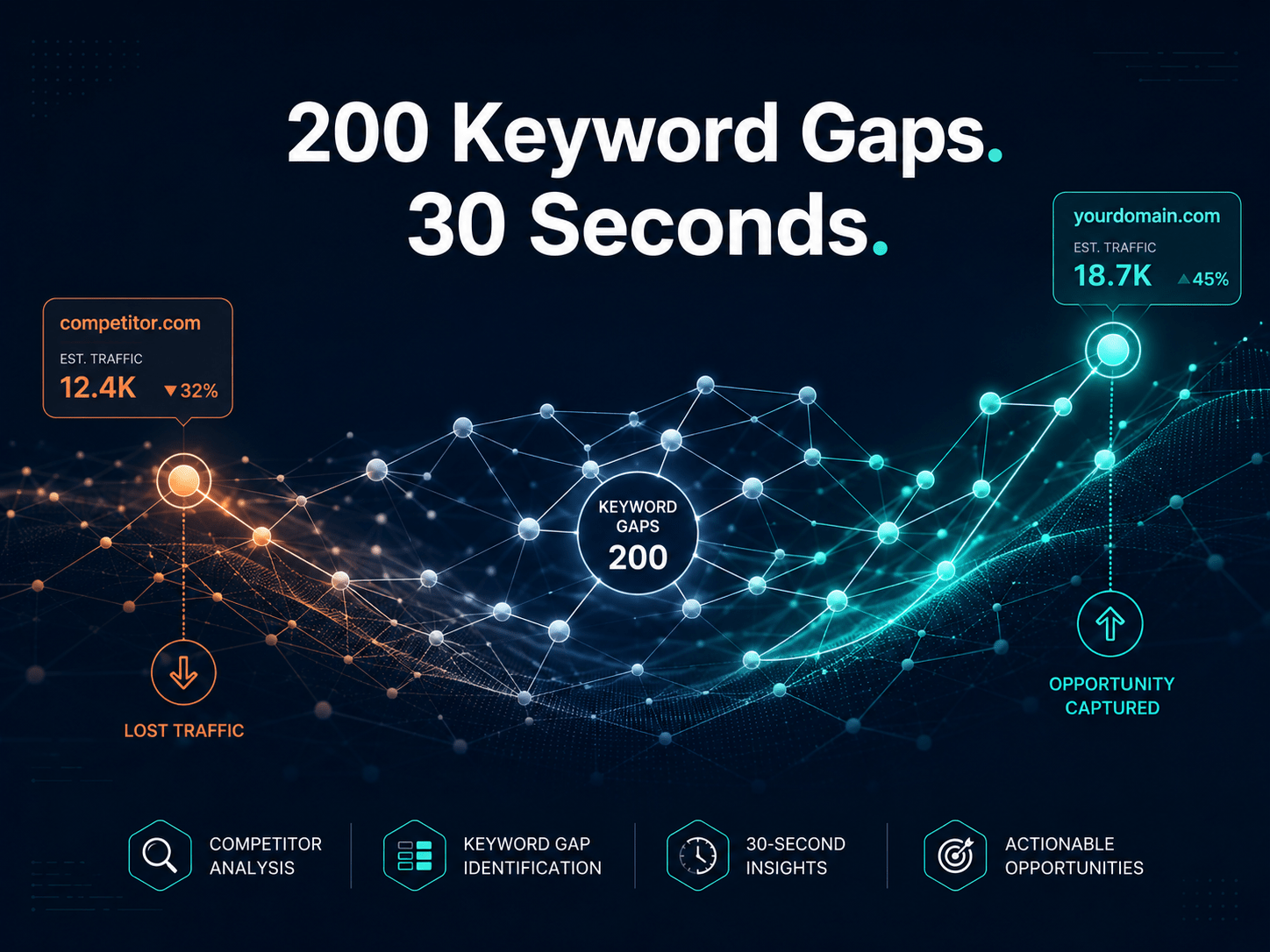
You feed it a competitor domain. In 30 seconds, it returns 200 ranked keyword opportunities. These are not random high-volume terms pulled from a generic database. They are specific gaps, keywords where your client’s competitors are generating search traffic and your client is absent or underranked.
The ranking logic prioritises intent, opportunity density, and competitive displacement potential. You are not just seeing what your competitors rank for. You are seeing where you can take traffic from them with the least resistance.
Stage 2: Psychology-Driven Headline Generation
For each keyword, the agent generates 50 unique headlines. The variation is not cosmetic. Each headline applies a different psychological angle: urgency, social proof, curiosity gap, benefit-forward framing, authority positioning, negative space framing (the “what to avoid” angle), and more.
A human copywriter generating 50 headlines per keyword at professional quality would take 45 minutes per term. For 200 keywords, that is 150 hours of work. The agent produces this output before your next client call.
Stage 3: The Self-Correcting Expert Panel
This is the piece that separates this from every other SEO headline generator on the market.
After generating the 50 headlines per keyword, the agent runs them through what it calls a “panel of 4 AI experts.” These are distinct evaluation lenses applied sequentially: SEO alignment, reader psychology, originality, and conversion intent. The panel scores each headline and evolves the weakest performers through 3 iterative rounds until the entire output clears an 85-plus quality threshold.
What comes out of Stage 3 is not a raw list. It is a validated, scored headline bank with a clear hierarchy of which headlines to test first, second, and third. That is a publishable deliverable on its own.
Two Deployment Paths for Two Types of Clients
The Unfair SEO Agent ships in both a CLI Edition and a Desktop Edition. This matters operationally because your clients are not all the same.
The CLI Edition is Python-based and built for developers who want to embed this workflow inside their existing automation stack. If you are running client deliverables through a Make or Zapier pipeline, or you are building a custom client portal that surfaces keyword data on a dashboard, this is the edition that slots in cleanly. You can trigger the keyword discovery automatically when a new client is onboarded, pipe the output into a database, and have the headline bank ready before the welcome call.
The Desktop Edition requires no setup. It runs directly inside Claude as a prompt-based workflow. For agency builders who are serving non-technical clients or who want to demo the output live in a client meeting, this is the faster path to showing results. You open Claude, run the Desktop Edition, and you have 200 ranked keywords and a scored headline bank on screen before the client has finished their coffee.
Most sophisticated agency operators use both: CLI for client delivery automation, and Desktop for sales demos and rapid iteration during discovery sessions.
The Agency Monetisation Model
Here is how the math works when you white-label or customise this agent for your service stack.
The keyword audit and headline bank represent a natural discovery deliverable. Before a client commits to a monthly SEO retainer, they want proof that you understand their competitive landscape. The Unfair SEO Agent gives you that proof in under an hour.
Agencies are currently pricing the initial discovery package at $1,500 to $3,500, depending on the scope: number of competitor domains analysed, number of keyword clusters covered, and whether the headline bank includes a recommended content calendar mapping each keyword to a production-ready brief.
Once the discovery deliverable lands, the retainer conversation becomes easier because you are not pitching strategy anymore. You are pitching the execution of a plan that the client has already seen and approved. Monthly retainers attached to this discovery package range from $1,200 to $4,000 per month, depending on content volume and reporting cadence.
The setup cost to deliver this service: the time it takes to run the agent and package the output. There is no junior analyst, no manual research phase, and no 40-page PDF that nobody reads.
Why This Matters at Scale
The agencies that are winning right now are not the ones with the biggest teams or the most expensive tooling subscriptions. They are the ones who have compressed the distance between the client brief and the client-facing deliverable.
A developer who takes the CLI Edition and wraps it in a lightweight client portal can deliver keyword intelligence as a product, not a service. That is a recurring revenue model with near-zero delivery overhead. A non-technical agency builder who runs the Desktop Edition can walk into a sales meeting, run a live competitor keyword analysis, and close the retainer in the room.
Neither of those outcomes was possible with manual SEO research. Both of them are the standard now for agencies that have added this to their stack.
The competitive gap in your client’s keyword landscape exists whether or not you have a tool to find it. The only question is whether you find it before their other options do.
Get full access and deployment details here: https://www.adam2scale.com/products/the-unfair-seo-agent/