
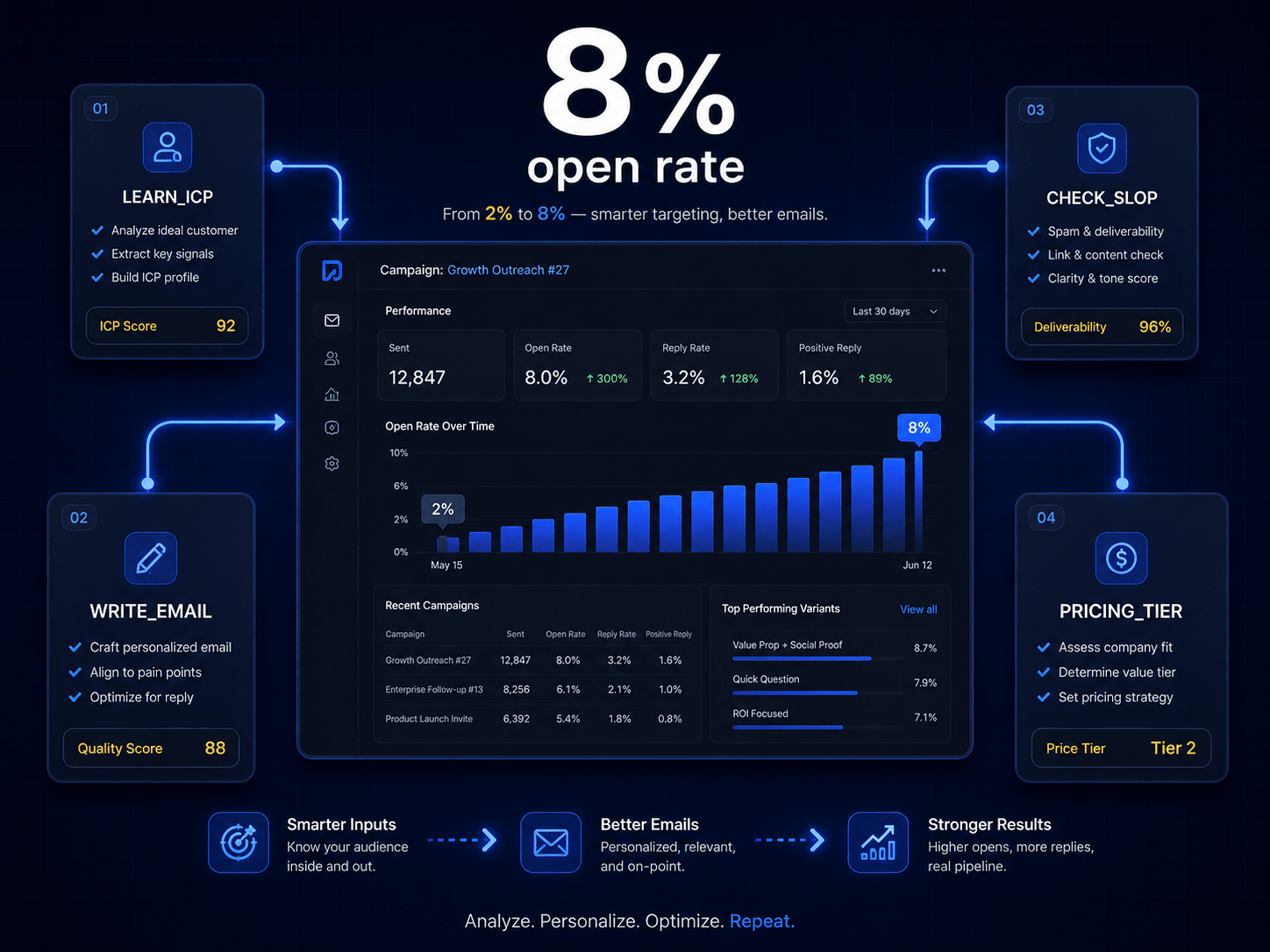
The Problem Is Not the Email. It Is the System Behind It.
Every agency owner has been in the same conversation. A client shows you their outbound numbers. A 2% open rate. A reply rate that barely registers. They have tried new subject lines. They have tested different senders. They have bought templates from a LinkedIn guru. Nothing moves.
The instinct is to write a better email. That is the wrong instinct.
The deeper problem is that nobody in that organization actually knows who they are writing to, why that person should care, or what angle will connect with that specific buyer at that specific moment. Without that, no amount of template optimization changes the fundamental math.
This is the gap the Cold Email AI Agent from Adam2Scale was built to close. And for AI agency owners, IT consultants, and automation builders, it is also a productized service that can generate $3,000 to $5,000 in setup fees per client deployment, plus a recurring monthly retainer.
What Is Actually Broken in Most Cold Email Stacks
Before examining the agent itself, it helps to understand the four failure modes that drive poor outbound performance for B2B clients.
The first is ICP drift. Most companies wrote their ideal customer profile once, years ago, based on who they wanted to sell to. They have never updated it based on who they actually close. The result is outbound activity aimed at the wrong segment, with messaging calibrated to a buyer who does not represent their real win rate.
The second is angle uniformity. Every email in the sequence sounds the same because it was built from the same template. There is no differentiation between a buyer responding to competitive pressure, a buyer in active hiring mode, or a buyer sitting on data they already have but are not using. These are three completely different conversations, but most sequences treat them as one.
The third is what the agent calls slop. Generic greetings, vague value propositions, filler phrases that any AI or template factory produces at scale. Spam filters recognize these patterns. So do buyers. Open rates drop, and no one knows why.
The fourth is pricing misalignment. Even when an email lands and a conversation starts, offers are often structured in a way that creates friction rather than removing it. Packaging and tier logic are rarely built around the buyer’s psychology.
How the Cold Email Agent Solves Each Failure Mode
LEARN_ICP: Building the ICP From Actual Win Data
The agent’s first module analyzes your client’s historical deal data. Not surveys. Not assumptions. It looks at closed-won deals, extracts patterns in the accounts that converted, and maps out the Ideal Customer Profile with win rates attached to each segment.
This is what makes the agent’s output different from a prompt-engineered email generator. It is learning from evidence, not generating from instructions. When you deploy this for a client, you are giving them a data-backed answer to the question “who actually buys from us,” which most companies have never had answered precisely.
WRITE_EMAIL: Three Angles, One Target, Under 150 Words
Once the ICP is established, WRITE_EMAIL produces three distinct outreach angles for the same prospect. The Hiring Signal angle identifies when a target company is expanding in areas relevant to your client’s offer and leads with that as the opening context. The Competitive Gap angle positions your client’s solution against a known weakness in a tool or competitor that the prospect is likely using. The Insider Data angle leads with a relevant industry or category insight that positions the sender as someone worth talking to.
Each angle stays under 150 words because length is the enemy of cold email. The goal is a single, clear reason to reply. Not a pitch deck in an inbox.
For your clients, you are delivering three ready-to-use, personalized angles per target account segment. For you as the agency builder, this is the core of a premium productized service.
CHECK_SLOP: The 24-Point AI-Slop Filter
This is the module that differentiates professional-grade output from what any user gets from a basic AI prompt. CHECK_SLOP scans every draft for 24 specific markers that reduce open and reply rates: generic greeting structures, vague value statements, overused CTAs, hollow social proof references, passive sentence constructions, and more.
The output is not just a flagged draft. It is a refined version with the slop removed and replaced with tighter, signal-driven language. When you are delivering cold email services to clients, this filter is your quality gate before anything touches a prospect’s inbox.
PRICING_TIER: Packaging the Offer to Match Buyer Psychology
When outbound generates interest, and a sales conversation starts, offer structure becomes critical. The PRICING_TIER module generates four distinct tiers for your client’s offer using value-based pricing psychology: Powerhouse, Value, Baseline, and Performance. Each tier is designed to anchor buyer perception and move decision-making toward the option that serves both parties best.
For your clients in SaaS, consulting, or professional services, this alone can shift close rates on inbound leads generated by the outbound campaign.
Two Deployment Paths for Agency Builders
The agent ships in two editions, and the right choice depends entirely on your client’s technical environment and your preferred delivery model.
The CLI Edition is the Python-based version built for developers and automation architects. You integrate it directly into a client’s outbound stack, connect it to their CRM for the ICP analysis, and automate the output pipeline so fresh email drafts are generated on a defined schedule. This is the version you would use to build a fully managed outbound-as-a-service offering, where you own the technical infrastructure and your client pays a monthly retainer for the continuous output.
The Desktop Edition runs inside Claude. No code required. You load the agent, feed it the inputs, and walk out of the session with the same ICP analysis, email angles, slop-filtered drafts, and pricing tiers. This is the version you use to deliver a high-value workshop or a one-time audit-and-setup engagement. You can serve a client in a single session and charge $2,000 to $3,500 for the deliverable.
The Agency Monetization Model
Here is the straight-line math. A client with a broken outbound motion is spending somewhere between $3,000 and $10,000 per month on tools, SDRs, or both, and getting a 2% open rate in return. You come in with a system that re-architects their ICP, generates tested email angles, filters for quality, and structures their offer.
The setup engagement is worth $3,000 to $5,000. The ongoing retainer, refreshing the ICP data, generating new angles, and tuning the slop filter for new campaign targets, is worth $1,000 to $2,500 per month.
You do not need ten clients doing this to build a legitimate agency revenue stream. Three clients at this price point is a $6,000 to $7,500 monthly recurring number from this service alone.
The agents are customizable, both editions can be white-labeled under your agency’s delivery process, and the underlying mechanics are solid enough to defend in a client presentation.
Closing the Gap Between 2% and 8%
The open rate gap between the average and top-performing outbound is not a writing-quality gap. It is a systems gap. The companies hitting 8-12% open rates have a process for knowing whom to target, which angle to use, how to filter out noise in their drafts, and how to package their offer in a way that earns a conversation.
The Cold Email AI Agent gives you that system, ready to deploy, and ready to sell to every B2B client in your pipeline who has ever complained that their cold outreach is not working.
Get the full agent and both deployment editions here: https://www.adam2scale.com/products/the-cold-email-agent/