
The Episode That Disappears
Your client records a 45-minute podcast episode. Maybe they drop $500 on editing, another few hundred on hosting, and spend two days promoting it through their personal network. It gets a few hundred listens in the first week.
Then it vanishes.
No clips. No threads. No LinkedIn series. No newsletter breakdown. The knowledge, the frameworks, the quotable moments that were sitting inside that recording just compressed themselves into an archive file and stopped working.
This is not a content quality problem. Most podcast content is genuinely good. It is a distribution infrastructure problem. And it is exactly the kind of problem AI agency owners should be solving for clients right now, at a premium.
Why Manual Repurposing Fails at Scale
The obvious solution is to hire a content editor or a social media manager to repurpose each episode. Some clients have tried this. What they find is that a skilled contractor can produce four to six pieces of content per episode, takes three to five business days to turn things around, and charges enough to make the unit economics painful for anyone producing more than two episodes per month.
Basic prompt wrappers are not much better. Feeding a transcript into a generic AI tool and asking for “some social posts” produces content that reads like content. It lacks the specificity that makes a LinkedIn post stop a scroll. It ignores the platform logic that separates a tweet that performs from one that disappears. And it produces nothing that resembles a distribution strategy.
What agencies need is not a prompt. It is a system with actual architecture.
How the Podcast Growth Engine Works
The Podcast Growth Engine is built around a five-step production pipeline designed to extract maximum distribution value from a single episode in approximately 20 minutes.
Step One: Content Atom Extraction
The system begins by parsing the episode transcript and identifying 15 to 20 Content Atoms. These are not random clips. They are the high-impact moments that carry the most traction potential: contrarian takes, memorable frameworks, specific data points, and personal stories with a clear arc. The extraction logic is built to prioritize shareability, not just relevance.
Step Two: Platform-Native Repurposing
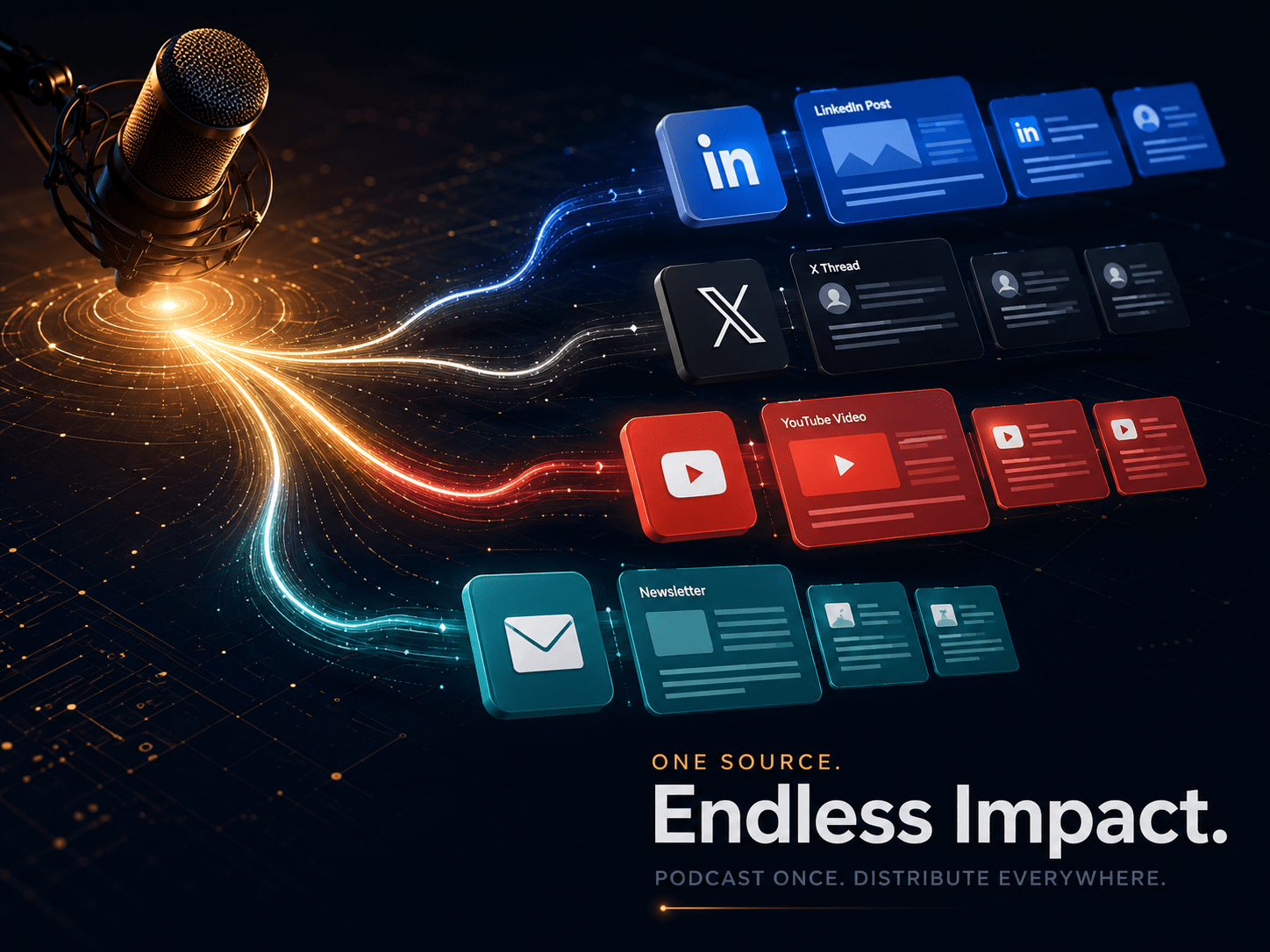
Each Content Atom becomes the raw material for platform-specific content. A Twitter thread gets built with Twitter’s scroll-stop logic in mind. A LinkedIn post follows a different structural rhythm. A YouTube Short script is timed for the format. A newsletter excerpt is written with a subscriber relationship in mind. The output is not one piece of content adapted to five platforms. It is five separate pieces of content, each engineered for a different audience.
Step Three: Viral Scoring
Every piece of content generated goes through a scoring model. The algorithm weights three variables: Novelty at 40%, Controversy at 30%, and Utility at 30%. Any piece scoring below the threshold gets flagged before it reaches the client. This means your agency never hands over filler content and calls it a deliverable.
Step Four: Headline A/B Testing
For every piece of content, the system generates three headline variants: an original, a curiosity gap version, and a benefit-driven version. Your clients can test across their channels and learn what resonates with their specific audience over time. You can position this as a data-backed optimization layer that generic content services simply do not offer.
Step Five: Automated Posting Calendar
The final output is a fully assembled weekly posting calendar. Platform-optimized. Pre-sequenced. Ready to hand to a scheduler. For clients who want to stay consistent on five platforms without burning out a content team, this is the infrastructure that makes it operationally possible.
Deploying This as an Agency Service
There are two edition paths depending on the technical profile of your client.
The CLI Edition is a Python-based implementation built for developers and automation-first agencies. If your client already has Zapier or Make workflows running, or if you are building inside a custom stack, the CLI gives you full control over how the pipeline integrates. You can pull transcript data from an existing API, push content output directly into a CMS or scheduling tool, and chain this into a broader content operations architecture.
The Desktop Edition is built for founders and marketing teams who are operating entirely within Claude. There is no code requirement. The entire workflow runs through a prompt-based interface that any non-technical operator can use reliably. This version is ideal when you are deploying to a client who has a strong content output but no technical infrastructure around it.
The Agency Monetization Model
When you bring the Podcast Growth Engine to a client as a service, you are not selling a tool. You are selling a content operations system with measurable throughput and consistent delivery.
The setup fee covers the technical implementation, the customization of the Content Atom extraction logic to the client’s brand voice, and the initial integration with their existing production workflow. This is comfortably positioned in the $2,000 to $4,000 range, depending on the client’s complexity.
The monthly retainer covers ongoing content production, calendar management, and performance reporting. At a rate of $800 to $2,000 per month, the math works for clients who are already spending more than that on a part-time content resource and getting fewer than 20 pieces per episode in return.
For agencies with multiple podcast clients, the compounding economics are significant. Three clients at a $1,500 monthly retainer is $4,500 in recurring revenue from a service that runs on a system you deploy once and customize twice.
Closing the Gap Between Episode and Revenue
The reason most podcast content stops working at publication is not laziness. It is the absence of a replicable production system. Your clients understand that content drives the pipeline. What they cannot build themselves, at a price that makes sense, is the infrastructure that turns one recording into a multi-platform presence that keeps distributing all week.
That infrastructure now exists. It is deployable in two formats. It fits both technical and non-technical client profiles. And it is available as a white-label service that your agency can add to your stack today.
Get full access and technical specs at: https://www.adam2scale.com/products/the-podcast-growth-engine/